Choosing a garage door company is about more than finding a name near the top of the search results. You need a clear assessment, suitable parts and someone who takes responsibility for the agreed work. Use these checks to compare your options before making a decision.
01 / KNOW WHO YOU ARE APPOINTING
Start with the business and the person attending.
Before booking, ask for the business name, contact details and the name or role of the person arranging the work. Find out whether the technician works for the business or is an independent contractor, and who will be responsible for the quotation, payment and any follow-up.
A company can use employees or contractors responsibly. What matters to you is clear accountability: you should know who you have appointed and who to contact if a problem remains after the visit.
Look for consistent details across the quotation, invoice and payment instructions. If something differs, ask for an explanation before paying. A search ranking, company registration, VAT number or professional-looking website should not replace these practical checks.
02 / RELEVANT EXPERIENCE
Ask about your type of door and motor.
Garage doors do not all work in the same way. A sectional door, a tip-up door and a roll-up door have different lifting arrangements and hardware. Timber condition, steel panel damage, spring balance and mounting space also affect the repair.
Tell the company what you have and ask whether they regularly work on that mechanism and motor model. Photographs of the complete door and the operator label can help with an initial enquiry, but a photograph is not a substitute for inspecting a mechanical fault.
For a new motor, ask how the operator and mounting kit will be matched to the door. A powerful opener is not a solution for a door that is jammed, damaged or badly balanced.
Explore garage door motor options ↗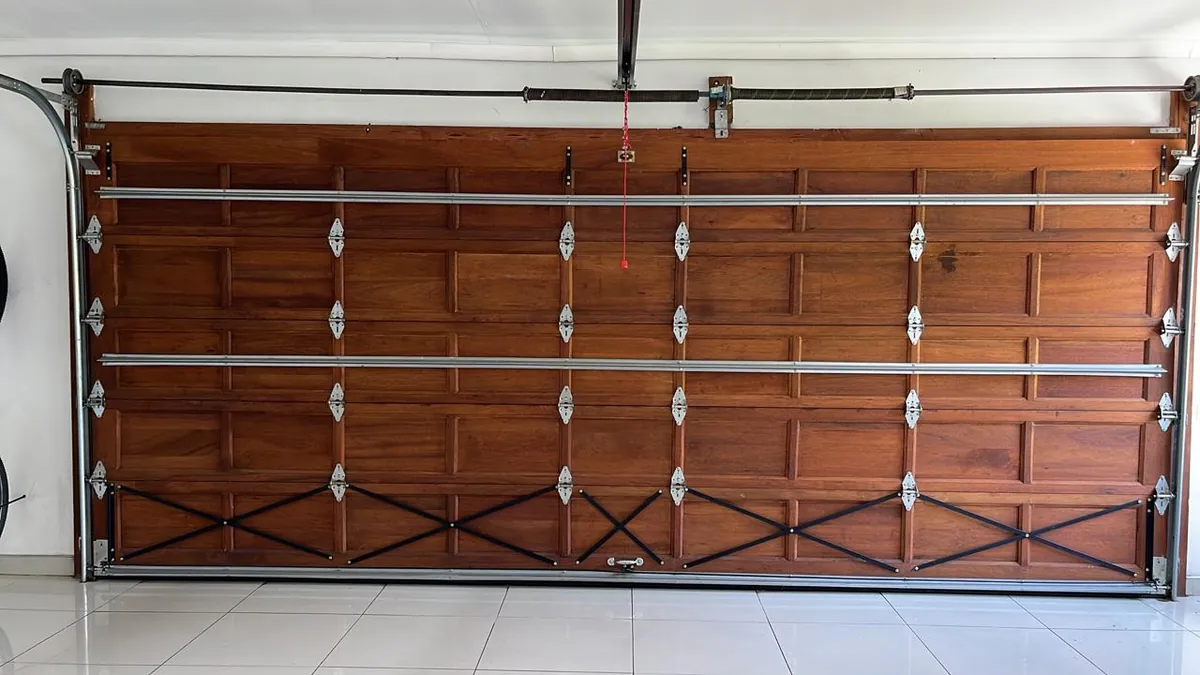
03 / UNDERSTAND THE RECOMMENDATION
Ask what failed—and why.
A useful inspection explains the symptom, the likely cause and the work needed to restore operation. If the door is crooked, for example, simply getting it moving again may leave a cable, drum, spring or track problem unresolved.
Ask the technician to distinguish essential repairs from optional improvements. If replacement is recommended, ask why a repair is unsuitable: is the existing part damaged beyond practical repair, unavailable, incompatible or likely to leave other problems unresolved?
Older equipment may still be repairable, but a promise that every legacy motor can be fixed is no more useful than a blanket instruction to replace everything. The explanation should fit the condition and parts available for your particular installation.
04 / COMPARE THE SAME WORK
Get a quotation you can understand.
A clear quotation should help you understand what you are buying. Confirm the labour, parts, assessment or call-out arrangements and any work that is excluded. If the final scope can only be confirmed after inspection, ask how additional work will be priced and authorised.
For repairs
Ask which components will be repaired or replaced, whether the replacements are new or reconditioned, and what related checks are included.
For a new motor
Confirm the model, rail or mounting kit, remotes, backup battery arrangement, safety equipment and commissioning included in the price.
For a new door
Confirm the size, material, finish, hardware, removal of the old door and any opening or building work that remains your responsibility.
For timber restoration
Discuss the extent of repairs, preparation, treatment and finish. Refinishing cannot correct every structural defect or guarantee a match to weathered timber.
The format of the document alone does not tell you whether the work will be good. Focus on clear details, consistent business information and an explanation of the total cost. Avoid proceeding when you cannot establish what is included or who is responsible.
05 / PARTS & PAYMENTS
Keep the agreement and the records.
If a part is being replaced, ask what is proposed and why it is suitable. On older motors or doors, compatible components may be limited. Confirm any substitution before it is fitted and ask whether the price assumes a particular brand or specification.
Discuss deposits, payment stages and the payment recipient before work starts. Retain the quotation, approval of changes, invoice and proof of payment. If payment details change unexpectedly, confirm them through a contact channel you already trust.
You can ask how removed parts will be handled and whether they can be shown to you. Leave inspection and handling of spring, cable and lifting components to the technician; do not mark or dismantle loaded hardware yourself.
06 / COMPLETION & AFTERCARE
Ask for a proper handover.
At completion, ask the technician to explain what was done and demonstrate the normal operation of the door and its fitted controls. Ask how the balance, travel and relevant safety functions were checked, and how to use the manual release under the manufacturer’s instructions.
Get the applicable warranty terms in writing. Clarify whether they cover parts, labour or both, what exclusions apply, and who handles a claim. A general promise of a “guarantee” is less helpful than a clear description of what is covered.
Ask what servicing the installation needs and what changes should prompt a call. A door that becomes heavy, crooked or unusually noisy should not simply be forced with the motor until the next planned service.
See our repair and maintenance services ↗07 / WHEN TO PAUSE
Be cautious when the explanation is missing.
Pause before approving work if you are pressured into an immediate decision without a clear fault explanation, cannot obtain a written scope, or receive changing payment instructions that cannot be independently confirmed.
Be equally cautious about a recommendation to bypass safety equipment or use a stronger motor to overcome a heavy door. Mechanical condition and the intended protective response need proper attention.
Reviews and recommendations can be useful, especially when they describe similar work and how the company handled follow-up. Consider the detail and consistency of that evidence alongside your own experience of the quotation and communication.
HOUSE OF DOORS & GATES
A clear starting point for your own enquiry.
Tell us your suburb, door type, motor model and what has changed. We can discuss an assessment for repairs, servicing, replacement or installation, and explain the next step for your property.
Our service pages cover garage doors, motors, springs, lifting cables, panels and related automation. For an existing fault, the recommendation depends on the condition of the full system and suitable parts.
COMMON QUESTIONS
Before you appoint a company.
Does a high search position prove a garage door company is reliable?
No. Search visibility can help you find companies, but you should still check who is doing the work, relevant experience, the written scope and what support is available afterwards.
Should I get a written quotation before work starts?
Ask for a clear description of the proposed work, parts, exclusions and the total price basis. Where diagnosis is needed first, confirm the assessment or call-out arrangements and how further work will be approved.
Does an old garage motor always need replacement?
No. The fault, condition and compatible parts availability determine whether repair is practical. Ask why replacement is recommended and what is included in the proposed new installation.
What should I ask after the repair?
Ask what was repaired or replaced, how the door and opener were checked, what warranty applies and what maintenance is recommended. Do not personally test a damaged or heavy door to verify the work.
Can I choose a company using price alone?
Compare quotations on the same scope. A lower total may exclude hardware, controls, disposal, finishing or other work included elsewhere. Ask for clarification so you understand the differences.
HAVE A DOOR OR MOTOR PROBLEM?
Tell us what needs attention.
Send your suburb, equipment details and a short description of the fault.
Make an enquiry ↗